
The world produces enough food to feed 10 billion people.
Yet 295 million go hungry. A third of every harvest is lost before it reaches anyone. The soil that sustains us is eroding faster than it regenerates. This is not a production failure. It is a failure of understanding — and that is exactly where we come in.
That's 1.3 billion tonnes per year — enough to feed every hungry person on Earth four times over.
Annual cost: $6–11 trillion. And we keep farming it anyway, adding more chemicals to land that has less to give.
Aquifers are depleting faster than they recharge. When the water runs out, the food runs out.
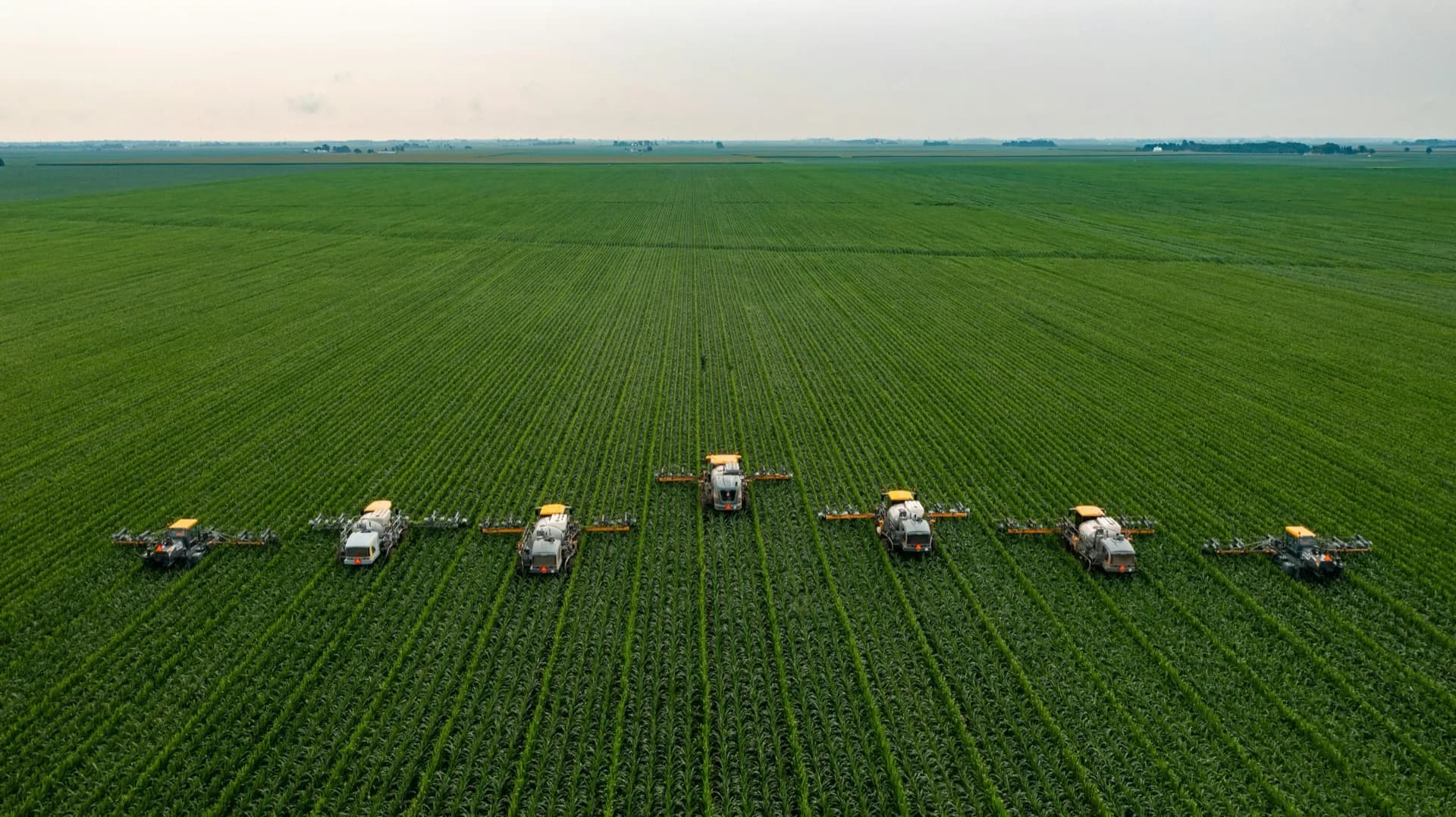
Carlos runs 12,000 hectares of corn. Last year his soil tests came back worse than ever. He was spending more on chemicals and getting less back. What if he could see a simulation of his fields three seasons out, and redesign his input strategy before it was too late? That is the kind of tool we are building. Not more chemicals, but more understanding. Farmers like Carlos should not have to guess what their soil needs. The data is already in the ground. Someone just has to read it.
Global Food Insecurity
What Went Wrong
Genetic Diversity Collapse
Three-quarters of crop genetic diversity has been erased in the last century. We grow the same handful of varieties across entire continents — optimized for yield in perfect conditions, catastrophically vulnerable to change. When a new pathogen arrives, it doesn't face diversity. It faces a monoculture. And monocultures fall.
The Chemical Treadmill
Fertilizer use per hectare has quadrupled since 1964. Pesticide resistance is accelerating. Each year we need more chemicals to achieve the same result — while the soil biology that once provided natural fertility is systematically destroyed. We are running on a treadmill that speeds up every season.
Climate Feedback Loop
Agriculture produces 26% of global greenhouse emissions — then suffers the consequences of the climate change it helped create. Droughts destroy harvests. Floods wash away topsoil. Rising temperatures shift growing zones faster than farmers can adapt. The system is consuming itself.
Every Drop Computed
Agriculture consumes 72% of global freshwater. Aquifers that took millennia to fill are being drained in decades. The Ogallala Aquifer under the American Great Plains — the source of 30% of U.S. irrigation water — is depleting 12 times faster than it recharges. In India, 54% of groundwater wells are declining. When the water runs out, the food runs out.
We are developing models of plant-water relationships at the cellular level — simulating stomatal conductance, root hydraulic architecture, and soil moisture dynamics to design irrigation protocols that deliver precisely the amount of water each plant needs, and nothing more. Our approach includes building digital twins of watershed systems to predict drought impact years in advance, enabling preemptive strategy shifts instead of reactive crisis management.
of freshwater consumed by agriculture
targeted water reduction
Ogallala depletion vs recharge rate
India's groundwater wells declining
Farming Redesigned from DNA Up
75% of crop genetic diversity has been erased in a century. The same handful of varieties are grown across entire continents — optimized for yield in perfect conditions, catastrophically vulnerable to change. Our approach scans the full genomic landscape of crop species — including wild relatives and ancient cultivars industrial agriculture forgot — to design varieties computationally in months instead of the decades traditional breeding requires.
Molecular Crop Design
Our AI is being trained to identify traits for drought tolerance, pest resistance, and nutrient density across the complete proteome. A variety that takes 15 years to breed conventionally — our target is to design, simulate, and validate it in under 6 months.
Predictive Field Intelligence
We are building models designed to simulate crop performance under dozens of climate scenarios simultaneously. Temperature, precipitation, pest migration, soil moisture — modeled at field resolution. The goal: prescriptive intelligence delivered before the season begins.
Pest & Disease Interception
We are developing molecular detection systems designed to identify plant stress signals weeks before visible damage. Our models will predict outbreak trajectories and inform biological countermeasures that can eliminate the need for broad-spectrum pesticides.
Nutritional Optimization
Food is molecular information. Our platform is being designed to map complete nutritional profiles at the metabolomic level — thousands of bioactive compounds beyond macronutrients. Tomatoes optimized for lycopene. Wheat with enhanced iron bioavailability. Food engineered to heal.
From Farm to Fork — Without the Loss
1.3 billion tonnes of food are lost or wasted every year — enough to feed every hungry person on Earth four times over. The problem is not production. It is the chain between harvest and consumption: inadequate cold storage, inefficient logistics, packaging that cannot communicate spoilage, and varieties bred for appearance rather than resilience.
We are applying molecular analysis to post-harvest biology — developing tools to predict spoilage timelines for individual shipments, optimize cold chain routing, design packaging materials that respond to decomposition signals, and engineer crop varieties with naturally extended shelf life. Our approach treats entire supply chains as biological systems, identifying the exact points where food is lost and designing molecular-level interventions to prevent it.
Rebuilding the Foundation of Life
A single gram of healthy soil contains up to 10 billion microorganisms across thousands of species. This invisible ecosystem makes agriculture possible — cycling nutrients, suppressing pathogens, retaining water, sequestering carbon. Industrial farming has systematically destroyed it. 1.7 billion hectares of land are now degraded. The annual economic cost: $6–11 trillion.
We are building digital twins of soil microbiomes — modeling the relationships between bacteria, fungi, plant roots, and mineral cycles at molecular resolution. Our computationally optimized restoration protocols will use microbial consortia, biochar formulations, and cover crop sequences designed to recover degraded land to productive capacity within a single growing season.
Compacted, depleted, chemically dependent. Less than 2% organic matter. Zero biological activity.
Recovery to reference ecosystem levels. Microbial diversity restored. Root network depth tripled.
Self-sustaining fertility. Carbon-negative. Chemical inputs eliminated. Yield exceeding pre-degradation levels.
Healthier Animals. Smarter Systems.
Livestock produces 14.5% of global greenhouse emissions and consumes one-third of all grain. Antibiotic resistance from industrial animal farming kills 1.27 million people per year. The current model is unsustainable — but the world's demand for animal protein continues to grow.
We are developing genomic-level models of animal health — designed to predict disease outbreaks before they spread through herds, optimize feed conversion efficiency to reduce waste, eliminate antibiotic dependence through molecular-level immune support, and inform breeding programs that produce resilient animals with lower environmental footprint. Every intervention will be validated computationally before it reaches the farm.
of global emissions from livestock
deaths per year from antibiotic resistance
of global grain fed to animals, not humans
Contamination Detected Before It Kills
600 million people fall ill from contaminated food every year. 420,000 die. Current testing catches contamination after it enters the supply chain — sometimes after it reaches the consumer. We are engineering molecular detection systems designed to identify pathogens, mycotoxins, pesticide residues, heavy metals, and allergens at concentrations invisible to conventional testing — in real time, at the source.
Detection alone is not enough. Our AI is being trained to model pathogen evolution — anticipating which food safety risks will emerge next, where they will appear, and how they will spread. The goal is prevention designed at the molecular level, deployed before the first case is reported.
people sickened annually by contaminated food
deaths per year from foodborne illness
targeted detection sensitivity vs conventional testing
From Soil to System
We are building across the entire food chain — not just one link.
A planet with limits demands a food system with intelligence.
Not more land. Not more chemicals.
More understanding.
SOURCES
- 295 million facing acute food insecurity — WFP, Global Report on Food Crises, 2023.
- 33% of food lost or wasted, 1.3 billion tonnes — FAO, The State of Food and Agriculture, 2019.
- 1.7 billion hectares of degraded land — UNCCD, Global Land Outlook, 2nd Edition, 2022.
- $6–11 trillion annual cost of land degradation — ELD Initiative / UNCCD, 2015.
- 72% of freshwater used by agriculture — FAO, AQUASTAT, 2022.
- 75% crop genetic diversity lost — FAO, The State of the World's Biodiversity for Food and Agriculture, 2019.
- Fertilizer use quadrupled since 1964 — Our World in Data, based on FAO and IFA data, 2023.
- 26% of global greenhouse emissions from food systems — Poore & Nemecek, Science, 2018.
- Ogallala Aquifer depletion 12x recharge rate — USGS, High Plains Aquifer Studies, 2020.
- 54% of India's groundwater wells declining — Central Ground Water Board, India, 2022.
- 14.5% of global emissions from livestock — FAO, “Tackling Climate Change Through Livestock,” 2013.
- 1.27 million deaths from antimicrobial resistance — Murray et al., The Lancet, 2022.
- 600 million ill, 420,000 deaths from foodborne illness — WHO, Food Safety Fact Sheet, 2022.
- $1 trillion supply chain food loss — FAO, 2019.
- 8% of emissions from food waste — UNEP, Food Waste Index Report, 2021.